Display and Control of the Infrared Sauna (AT-Series)
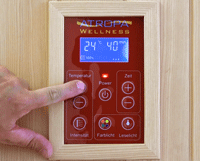
The control of the Infrared Sauna is simple and intuitive via the high-gloss display and can be operated from both inside and outside. It is also possible to change the desired temperature, the heater intensity, the remaining time, or the light options during the session. This is done simply by pressing the respective symbol. The settings are displayed promptly and directly on the LCD screen.



Function Overview
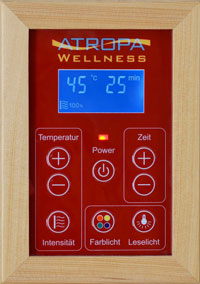
The control of the Infrared Sauna is the same for both inside and outside. The following settings are possible:
Time Setting
- easy operation by pressing "+" or "-"
- adjustable from 1 to 60 minutes, can be changed at any time
- low electricity costs: € 0.20 to € 0.40 per session
- recommended session duration: 20 min to 45 min
Temperature Setting
- easy operation by pressing "+" or "-"
- proven thermostat circuit
- adjustable from 25°C to 65°C
- recommended cabin temperature: 35°C to 55°C
Intensity Control
- Setting: 100%, 75%, and 50% intensity possible
- strong reading light, one for each seat
- color light therapy with 6 colors, single and alternating mode
Light Settings
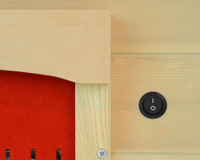
In addition to the settings on the display, there is also the option to switch all infrared heaters on or off separately. This is done directly next to the respective infrared heater using a mechanical switch.
This allows for energy savings on the one hand, and on the other hand, it contributes to the greatest possible customization of the Infrared Sauna. The position of the switch indicates whether the infrared heater is switched on or off.
Solid Control System
All control elements are carefully tested for quality and durability before market launch. The circuits undergo a thorough testing procedure to meet the high demands for use in Infrared Saunas. Precise attention is paid to the correct dimensioning matching the energy consumption as well as to heat resistance. Clean wiring and the thermally optimal arrangement of the elements are mandatory.
Should a problem ever occur, all elements can be easily replaced.